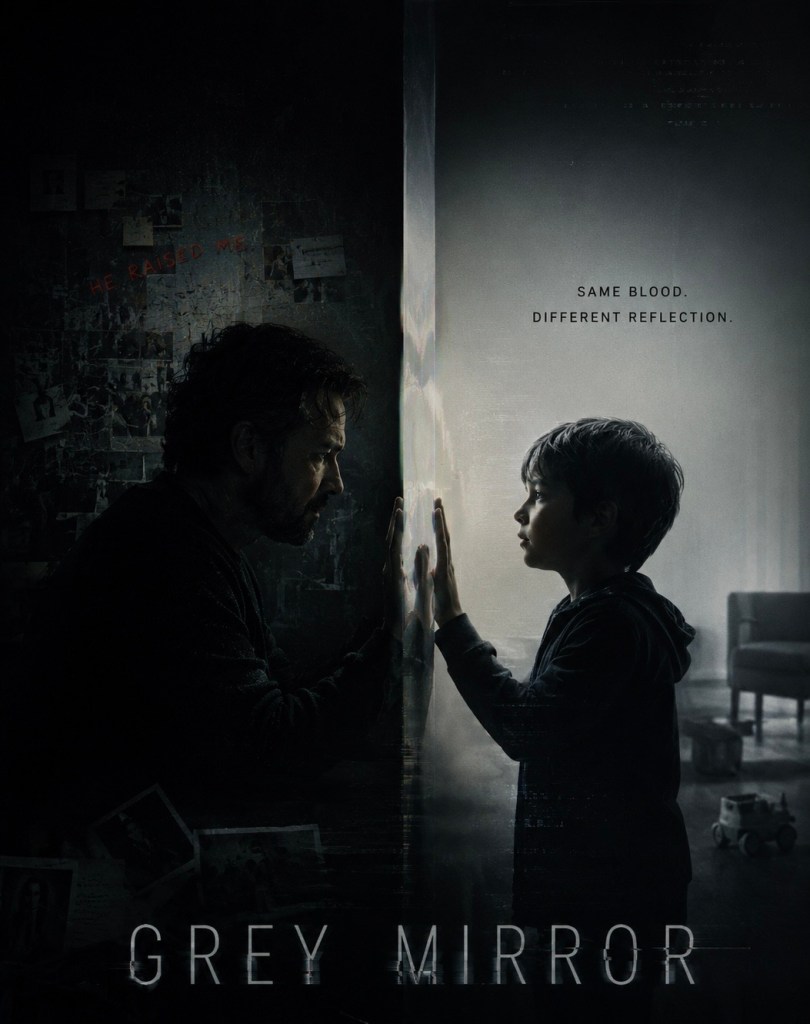
Father’s Day Special.
India, 2047.
A fiction
Zorawar found the paper by accident.
He was seventy-one days into being a father himself, looking for his own birth certificate in his father’s old steel trunk, the kind that smells of mothballs and a life folded too many times. His son Kabir had just had his first Saanjh, the ceremony every Indian household now held when a child’s mind opened enough to transmit its first independent thought. Kabir’s first thought had been clumsy, half formed, eighty percent intact at best. Zorawar had cried that day, the way fathers do when something in their child works exactly the way it should.
He was not looking for grief. He found it anyway.
Folded inside an old LIC policy envelope was a bank loan sanction letter dated 2027. Below it, a property sale deed, ancestral land in a village called Bisrakh, sold for thirty-eight lakh rupees. And below that, a contract. A name he had never heard. Yashpal Tomar. Seller. Lifetime Cognitive Archive, Tier 3, Transferable.
Zorawar sat down on the floor of a house his father no longer lived in, and understood, at thirty-four years of age, exactly how he had become himself.
I. The Consultation
Twenty-eight years earlier, Raghuveer had sat in a government primary health centre in Ghaziabad, across a desk from a tired neuro-counsellor, listening to a sentence that would not leave him for the rest of his life.
“Your son’s mind works differently, Raghuveer ji. Not less. Differently.”
In 2019 this would have meant therapy, patience, a long road of small victories. In 2047 it meant something far more brutal.
By then India had moved past language. The Sanchar Grid, laid down nationwide after the Neural Integration Act of 2038, let citizens transmit thought directly, mind to mind, idea to idea. A farmer in Bisrakh could share the exact ache in his back with a doctor in Lucknow without a single word passing between them. Children no longer learned to speak so much as they learned to project, clearly, efficiently, the loss rate sitting at a tolerable twenty percent for most well-trained minds. Hindi and English still existed, the way Sanskrit had once existed. Spoken, but mostly at temples, courtrooms, and wedding mandaps, ceremonial now, ornamental.
Four-year-old Zorawar could not project. His thoughts arrived at the Grid scrambled, looping, sometimes not arriving at all. In a world where communication had become instant and total, his son was, for the first time in human history, more alone than any child before him had ever been.
The counsellor had a solution, the way the wealthy always have a solution.
“There is a market, Raghuveer ji. Cognitive Archives. People who built strong, efficient, well-trained minds across a lifetime, they can sell the architecture before they go. Not memories. Not personality. Just the scaffolding, the part of the mind that knows how to think clearly, project cleanly, hold an idea without losing it in transmission. Expensive. But for a child like Zorawar, it would not be an upgrade. It would be a bridge.”
Raghuveer asked the only question that mattered to a junior architect earning eighty thousand rupees a month.
“How expensive?”
II. The Market
The portal was called CogMandi. Everyone just called it the LLM Bazaar.
Old India had Olx for scooters and sofas. New India had CogMandi for minds.
People listed themselves the way they once listed used cars, certified, graded, mileage disclosed. A retired IAS officer’s archive went for two crore. A senior High Court advocate’s, one crore eighty. A failed UPSC aspirant who had nonetheless built a startup that didn’t survive, forty lakh, “good for entrepreneurial cognition, slight overthinking tendency, priced to reflect.”
Every listing carried a CIBIL-like number, except this one did not measure your debt. It measured your worth. The Samajik Credit Score, a single figure that fused your education, your income, your social conduct, your professional output, into a number that decided how much your mind would fetch when you were too old to need it anymore. The poor sold cheap minds. The rich sold expensive ones. And the children of the poor, the ones who needed it most, could afford only the cheapest.
Raghuveer scrolled for three nights straight, Asha asleep beside him, Zorawar asleep in the next room, dreaming thoughts that no one else could hear.
He found Yashpal Tomar at two in the morning.
A retired junior college mathematics teacher from Meerut. Credit score modest, by CogMandi standards. Forty-one years of teaching, never wealthy, never powerful, but a mind, the listing said, of unusual clarity, patient, structured, capable of holding a difficult idea steady long enough for a slower mind to catch up. Ideal for developmental transfer, the listing read. Priced for accessibility.
Thirty-eight lakh rupees. A schoolteacher’s mind. Affordable, in the way that selling everything a man owns can make anything affordable.
Raghuveer sold the Bisrakh land his own father had left him. He took a loan against his salary that would not finish paying itself off until Zorawar turned twenty-six. He started a second shift, drafting building plans through the night for a contractor who paid in cash and never asked why a man who used to leave by six now stayed till midnight.
Asha watched her husband disappear into work the way water disappears into sand, completely, without a sound. She never once heard him say he was tired. He never once let her see him cry. What she saw instead was a man who came home from double shifts and sat by Zorawar’s crib for an hour before sleeping, not speaking, not projecting, just sitting, the only language he still had left being presence.
III. The Transfer
The procedure took four hours at a clinic in Noida that smelled of antiseptic and ambition.
They did not give Zorawar Yashpal Tomar’s memories. They did not give him Yashpal Tomar’s life. What they gave him was architecture, the scaffolding of a mind that knew how to hold a thought steady, how to organise it, how to send it out into the Grid clean and whole instead of broken and lost.
It was not a replacement of Zorawar. It was an amplifier for a Zorawar who had always been there, fully formed, fully intelligent, but trapped behind a signal that kept failing.
The doctors called it Tier 3 Cognitive Scaffolding. Asha, watching her son open his eyes after the procedure and, for the first time in his life, project a single clear thought, Maa, called it a miracle.
Raghuveer called it nothing at all. He simply turned away so no one would see his face.
IV. The Boy Who Never Knew
They never told him.
It was not deception, not exactly. It was the particular silence of parents who have decided their child should never have to carry what they themselves carried. Raghuveer reasoned, in the only way a proud and broken man can reason, that if Zorawar grew up believing his mind was entirely his own, he would never once doubt himself. He would never wonder if his cleverness was borrowed. He would simply be clever, the way other children simply were tall or simply had their mother’s eyes.
It worked, in the way that lies built from love often do.
Zorawar grew up sharp, articulate, his thoughts landing in the Grid with a precision other children envied. School came easy. The Personal Cognitive Refinement classes, mandatory now from age six, the ones where wealthy children arrived with private tutors who fine-tuned their minds like Ferraris while government school children made do with overcrowded labs and outdated scaffolding software, those classes were where Zorawar first felt the gap between the rich and everyone else. But he never felt it as his own gap. Whatever Yashpal Tomar had given him held its shape, steady, structured, clear, in a world that was rapidly deciding that only the wealthy deserved minds like that.
At eighteen he built his first idea on the Grid, a peer-to-peer micro-lending network for farmers, projected to three investors with such clarity that all three of them found themselves, against their own commercial instincts, agreeing to fund it. At twenty-five he was called a prodigy. At thirty he was called a visionary. Magazines used the word self-made, a phrase that had survived from a century where it once meant something simpler.
Raghuveer watched his son’s rise from a small flat in Ghaziabad, never moving in with him no matter how many times Zorawar offered, never once telling him why he refused.
He died at sixty-one, an ordinary heart, tired earlier than it should have been. Zorawar grieved the way successful sons grieve, fully, expensively, a funeral with all the rites done properly, and an ache he could not yet locate the source of.
It took him eight more years, and a son of his own, to find it.
V. The Tender Coconut
Fatherhood, Zorawar was learning, asks questions that success never does.
Watching Kabir struggle through his Saanjh, watching the boy’s small face crumple in frustration when a thought refused to project cleanly, Zorawar felt something move in him that he did not have a name for. He found himself doing what his own father used to do, sitting beside the crib, not speaking, not projecting, simply present, as if presence itself could be transmitted when nothing else could.
It was in this state, half memory, half ache, that he opened the steel trunk.
And found Yashpal Tomar.
He searched the name on what remained of the old internet archives, the parts that still existed outside the Grid, the way old temples still exist beside new highways. A retired schoolteacher. Modest pension. Sold his cognitive archive in 2027 to fund his daughter’s wedding, the article said, daughter, not son, Yashpal Tomar himself had no son to give his mind to. He had given it, instead, to a stranger’s child in Ghaziabad who needed it more than his own blood did.
Zorawar sat with that fact for a long time.
He understood, now, the thirty-eight lakh rupees. He understood the ancestral land in Bisrakh that he had never once asked about. He understood why his father had refused to move into his son’s grand house in Gurugram, choosing instead to live and die in a flat that still smelled faintly of the double shifts that had paid for a mind not his own.
He understood, finally, the particular silence of his father, a man who never once said I love you in thirty years, but who had sold his father’s land, broken his own back, and carried a secret to his grave, all so that his son would never have to know he was once a boy the world had no place for.
Indian fathers, Zorawar thought, are like tender coconuts. Hard outside, soft within, and you only ever find the water if you’re willing to break something to get there.
He held Kabir that night longer than usual. The boy’s thought arrived, fragile, looping, only sixty percent intact. Papa.
Zorawar did not correct it. Did not refine it. Did not wish, even for a moment, that his son’s mind worked like his own.
He simply held him, and let the sixty percent be enough.
VI. Conclusion
Raghuveer never once told his son he loved him in a language Zorawar could understand. He told him in thirty-eight lakh rupees, in double shifts, in a silence that asked for nothing back. The Grid measured efficiency in percentage points of meaning successfully transmitted. It never measured the part that mattered most, the twenty percent that gets lost is not failure. Sometimes it is the only place where love, too large for any signal, chooses to live instead.
This Father’s Day, somewhere between the eighty percent we manage to say and the twenty percent we never do, ask yourself.
What is your father still trying to tell you, in the silence you mistook for distance?